A new chapter for our Legendary safari experiences
Legendary Expeditions and Chem Chem Safari have joined the Auberge Collection, uniting nine exceptional properties across Tanzania’s most iconic wildlife destinations under one visionary new brand: Auberge Safari.
For travelers and trade partners, this means the same True. Wild. Free experience you know and trust, now seamlessly connected in an unrivaled portfolio of luxury safari camps and lodges.
As Auberge Safari takes flight, Legendary Expeditions is stepping into a new role as your premier partner for Auberge Safari journeys, crafting extraordinary experiences across northern Tanzania — and beyond. Return on June 1, 2026 to find out more
Something fundamental has shifted in luxury safari — and in how we approach travel itself. I've felt it in my own journeys, and I hear it in conversations with fellow travelers: we're asking different questions now. Not just "where should I go?" but something that cuts deeper: "why am I going? What will this journey mean when I reflect on it?"
In this new era, intention shapes everything — where the "why" behind our travels matters as much as the "where." As you explore the trends defining safari in the year ahead, you'll notice this thread of intentional travel woven through each one, quietly revolutionizing the luxury safari experience.
So before you plan your next journey, pause and ask yourself: what is your why?
Breakfast views at Legendary Mwiba Lodge
1. Make way for the 'Whycation'
Meaningful travel is having its moment
The days of safari as mere wildlife viewing are evolving. Rather, today's safarigoers seek a deeper connection with their destinations and prioritize experiences rooted in positive social and ecological impact. This is the 'whycation' — where travel is driven by purpose rather than simply pleasure.
The ‘whycation’ isn't performative. It's a fundamental reframing of what safari means: from passive observation to active participation in positive change. Here, conservation-led safari properties take center stage. By offering experiences that directly support conservation and community development, these safaris bring the ‘why’ to the forefront: your journey with us helps to protect the magical landscapes you’re experiencing.
I witnessed this firsthand one morning while eating breakfast at Legendary Mwiba Lodge, when I learned that the honey drizzled over my fruit and yogurt was harvested from hives at a nearby apiary — part of the Friedkin Conservation Fund's community-led beekeeping project. This brief moment offered a glimpse into a bigger picture: one in which tourism supports initiatives like these that help empower local communities.
The Serengeti plains at Legendary Mila Tented Camp
2. Escaping the noise with ‘hushpitality’
Seeking space to switch off
In an increasingly noisy, hyperconnected world, a safari offers something rare and sought after: genuine disconnection. More and more travelers are seeking what the industry calls "hushpitality" on holiday — and this experience is finding its most authentic expression here in the African wilderness.
This trend is driving demand for experiences that deliver true wilderness immersion — places where digital detox isn't just encouraged but inevitable. Here, the tranquility of nature becomes the perfect backdrop for restorative rituals where relaxation and reflection are woven into every moment.
There’s something magical about finding a place where you have no choice but to pause and reset. To me, this was Legendary Mila Tented Camp, tucked away in a remote corner of the Serengeti. With only canvas between me and the wild, I found myself genuinely switching off for the first time in months. Here, work stresses melted away as the sounds of nature replaced notifications — birdsong at dawn, the wind whispering through the grasses, the distant chorus of hyenas at night.
The jetlag menu at Legendary Lodge
3. Wellness reimagined
A holiday for your health
While the pursuit of wellness is nothing new, its definition is rapidly evolving. In 2026, wellness is less about fancy treatment rooms and more about recognizing that a holiday can, in itself, be inherently restorative. And there’s no better example than a safari: the early mornings, the fresh air, the rhythms of nature, and the quiet moments soaking up the scenery — these are, in essence, the embodiment of the wellness experience.
To align with this trend, the focus has shifted to design that prioritizes mental restoration alongside physical comfort. Biophilic architecture that blurs boundaries between inside and outside. Farm-to-table cuisine that nourishes rather than simply sustains. Spaces for contemplation alongside opportunities for adventure.
The allure of this holistic approach to wellness revealed itself when I arrived at Legendary Lodge severely jet-lagged. It was the lodge’s well-being-centered experience, not a simple massage, that truly helped me feel human again. The jetlag menu served in the comfort of my room. A shady trail that provided the perfect setting for a head-clearing jog. And, when staff noticed my exhaustion, being led to a shady spot on the lawn where I could journal and simply relax.
Book a private side of camp at Legendary Songa Migrational Camp
4. A family lens on adventure
Multi-generational travel gains momentum
Families are increasingly seeking to create lasting legacies through shared travel — where stories exchanged around safari campfires become the stories parents tell their children, who will one day tell their own. This is travel as heritage, as heirloom, as something to be treasured together.
This trend continues to drive more inclusive safari experiences where everyone, from toddlers to grandparents, can engage meaningfully with the wilderness. That means new priorities, for example, flexibility: shorter game drives for young children, walking safaris for teenagers seeking adventure, and photographic hides for grandparents preferring slower-paced observation.
At Legendary Mwiba Lodge, I found myself in conversation with a Mexican couple celebrating their anniversary with their children and grandchildren. They explained how they’d just come from Legendary Songa Migrational Camp, where exclusive-use partitioning had made them feel as though they had an entire camp to themselves. "It was magical," the wife said, "Our grandchildren could be as loud as they wanted, and we never felt like we were disturbing other guests."
Game drives in Maswa Kimali without anyone else around
5. Beyond the Big Five
A push to end overtourism
Off-the-beaten-path experiences are increasingly desirable as travelers seek smaller, lesser-known destinations with fewer crowds and a promise of authentic encounters — intimate, uncrowded moments in which wildlife sightings neither disturb nor obstruct animals
This means a shift from bustling national parks toward private reserves, remote wilderness areas, and emerging destinations. Why choose destinations where a leopard sighting means jostling with 20 other vehicles for a glimpse when you can visit exclusive-use areas where wildlife encounters unfold naturally without crowds?
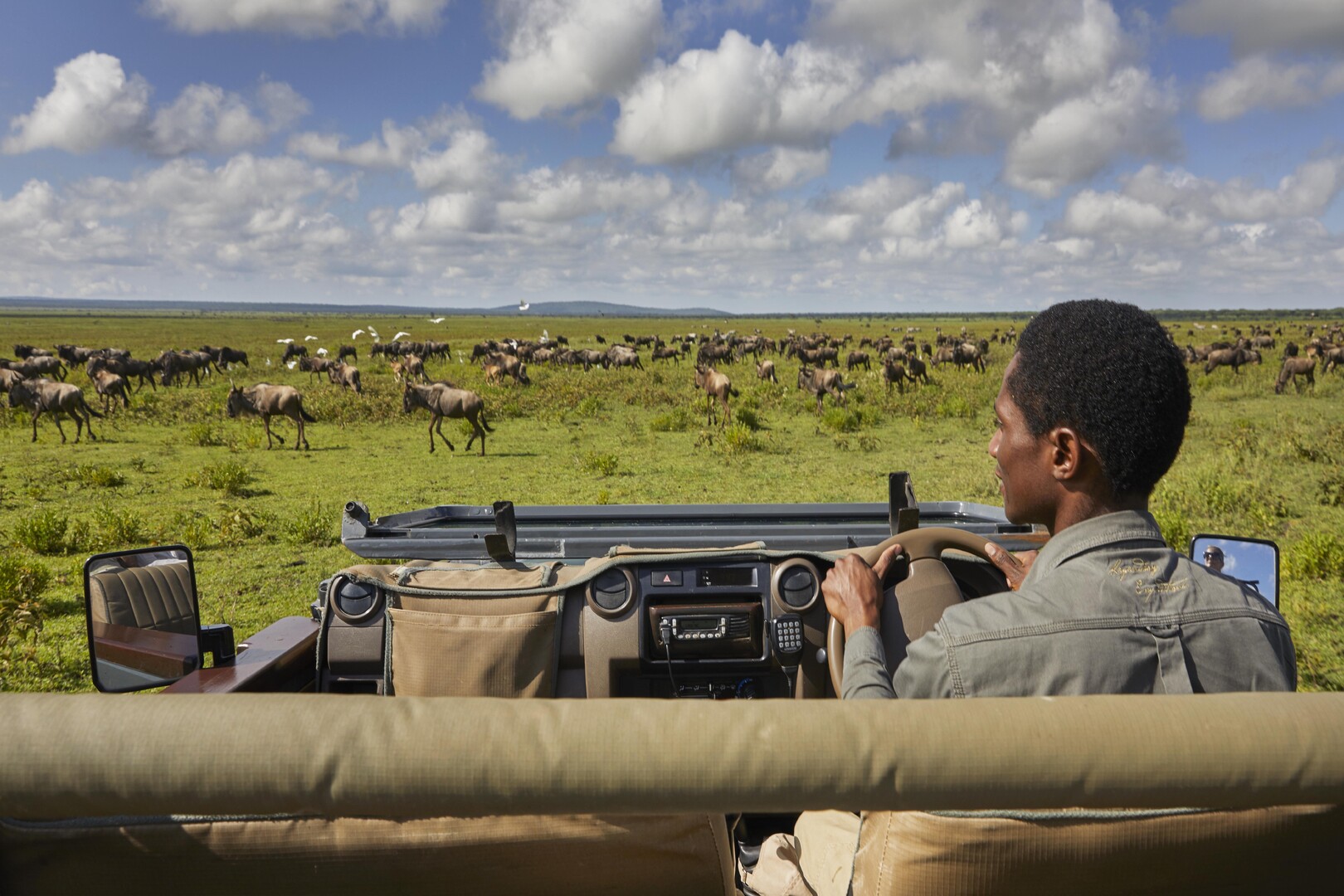
I experienced this contrast starkly during my travels. At the Mara River crossings, I found myself in the midst of a multitude of vehicles parked at the river’s edge. The crossing itself was extraordinary, but the human spectacle around it was distracting. How different it was seeing the calving season in the exclusive-use Maswa Kimali protected wildlife area. There, in total seclusion, I watched newborn wildebeest take their first steps with only my guide beside me.
Foraging through the wilderness with the Hadzabe tribe
6. People shaping sense of place
A push for cultural connection
Safaris are expanding beyond game drives as travelers no longer view wildlife and culture as separate experiences. Instead, they're recognizing that Africa's human stories are as compelling as its animal ones, and that genuine safari experiences should honor both.
This drives demand for visits to local communities. Meals featuring traditional cuisines prepared by local chefs who share the stories behind each dish. Guides who highlight not only animal behavior but also the traditional knowledge systems and cultural practices shaped by the wild.
Here, authenticity is everything. Today's travelers can distinguish between genuine cultural exchange and performative tourism, opting for meaningful interactions that recognize local communities as partners rather than exhibits.
One of my favorite safari memories was trying — and largely failing — to keep up with the Hadzabe as they moved effortlessly through the bush in search of wild honey. I watched in awe as they harvested the honey using ancient methods passed down through generations. As we sat together and shared the fresh honey, I understood what authentic cultural connection truly means. This wasn't a performance, it was an invitation into a way of life that has endured for thousands of years.
Solo women travel at Legendary Mila Tented Camp
7. The rise of solo women travelers
Shifting the safari perspective
Women have emerged as the new face of solo travel. As such, the demand for safaris that genuinely center the female perspective — from safety considerations to solo-traveler provisions — is growing.
However, accommodating solo women travelers is about more than just making provisions for people traveling alone; it’s about recognizing that women often prioritize different aspects of safari: community engagement, conservation impact, cultural authenticity, and meaningful connection over bucket-list sightings.
Nowhere, as a solo woman traveler, have I felt more at home than during my journey with Legendary Expeditions. The staff were friendly and easy to chat with, yet remarkably attuned to my needs — they seemed to instinctively know when I welcomed company and conversation, and when I preferred quiet moments to myself. The askaris who walked me to my tent each night with their lanterns made the darkness feel safe. And, my private guide, who was with me at every stage of my journey, created a sense of security and continuity as I moved between properties.
Field notes
As safari enters this new era, a common thread emerges: authenticity. Whether seeking purpose, silence, restoration, or connection, today's travelers are turning away from performative luxury toward intentional and transformative experiences.
The new luxury isn't about what guests are offered — it's about what they take away. It’s stories rather than just photographs, impact rather than just itinerary, and meaning rather than just milestones.